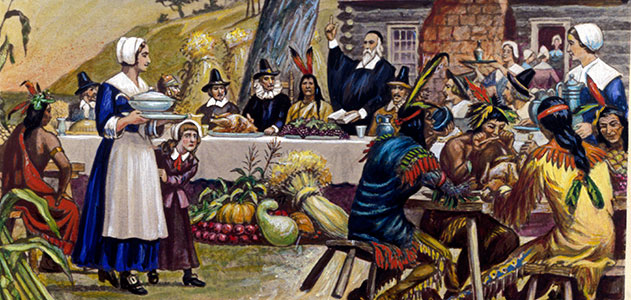
This week millions of kindergarteners dressed in paper Pilgrim hats or Indian headdresses. They learned how these English adventurers came over on the Mayflower in search of religious freedom, and in 1620 at Plymouth Rock, gave birth to the American experiment. They also learned of friendly Native Americans like Squanto who cheerfully helped the settlers.
For instance, the passengers of the Mayflower were not the first settlers in the New World. Obviously, people had lived here for about 12,000 years—likely much longer.
Okay, then. The first European settlers. Wrong again. You’ve heard of that group seeking religious freedom, right? The Spanish Jews who made their homes in what is now New Mexico in the late 1500s? Thanks to the Spanish, America now has horses, cattle, sheep, and pigs. None of these are native to the Western Hemisphere.
Okay, okay. So they weren’t actually the first. No. And they didn’t exactly carve a colony out of the wilderness. Likely due to European fisherman off the Massachusetts coast, diseases unfamiliar to the native population ravaged between 90 and 96 percent of them. Entire villages were deserted. According to Loewen, the Pilgrims “chose Plymouth because of its beautiful cleared fields, recently planted in corn, and its useful harbor and ‘brook of fresh water.’ It was a lovely site for a town. Indeed, until the plague, it had been a town…”
Also, the kindly Squanto, who “mysteriously” knew English, may have learned it when he was kidnapped by an English slave trader in 1614 and sold into slavery in Malaga, Spain.
Wonder if they’ll act that out in kindergarten.
 M.B. Gibson Books
Leave a comment