Coming of age in the mid- to late- sixties, I saw peaceful marchers assaulted with fire hoses and attack dogs on the news. I was ten when Martin Luther King gave his “I Have a Dream” speech, eleven when John Lewis led voting rights activists across the Edmund Pettus Bridge, and fourteen when MLK was gunned down.

I was outraged even then, reading books called Black Like Me by John Howard Griffin and researching Georgia’s racist governor, Lester Maddox, for an assigned term paper.
So, the fact that I’d never heard of the horrific Tulsa Massacre until its one-hundredth anniversary in 2021 stunned me.
If you’ve yet to hear of it, an African-American district in that city informally known as “Black Wall Street” was attacked one Spring night by local white supremacists. They burned 35 square blocks of homes and businesses, killing and maiming its citizens. Records list anywhere from 36 to 3000 dead and 800 hospitalized.
Amazingly, an 111-year-old survivor called Mother Viola Fletcher just passed away last November. She testified before Congress with two other centenarians in 2021, saying, “I still see Black men being shot, Black bodies lining the street. I still smell smoke and see fire. I still see Black businesses being burnt. I still hear airplanes flying overhead. I hear the screams. I live through the massacre every day. Our country may forget this history. I cannot. I will not.”
Award-winning author, Vanessa Miller, has written a fictionalized account of the atrocity called The Filling Station. I had the privilege to co-host a Zoom meeting featuring her for the South Carolina Writers’ Association’s monthly event, Author’s Toolbox. She is a delight.

One of the many topics Vanessa discussed was why she chose fiction over nonfiction. It spoke to me. Nonfiction includes names, dates, and facts. Those are important. However, fiction can focus on the emotional experience of an event or time period.
She explained that other accounts or stories stopped with the massacre. She feels the importance of taking it further, exploring the emotional trauma that Viola Fletcher described, still fresh from her ten-year-old mind.
Vanessa Miller explored three fictional characters, sisters Margaret and Evelyn Justice, and a young man named Elijah who, with others, came to their assistance. In a very authentic way, she showed how different individuals dealt with the trauma, allowing us into their heads and hearts.
This emotional connection with people from the past is what gives historical fiction its power. It’s why I write in the genre. Whenever I read about a certain time and place, I ask, “But what was it like? How did it feel to live through this?”
Despite the depressing nature of the story, Vanessa Miller manages to demonstrate the resilience of the people. Reminding us that we, too, can come back from our losses. To see her bright face, you would expect nothing less than a story that exemplifies one of my favorite sayings:
“Fall down seven times, stand up eight.”
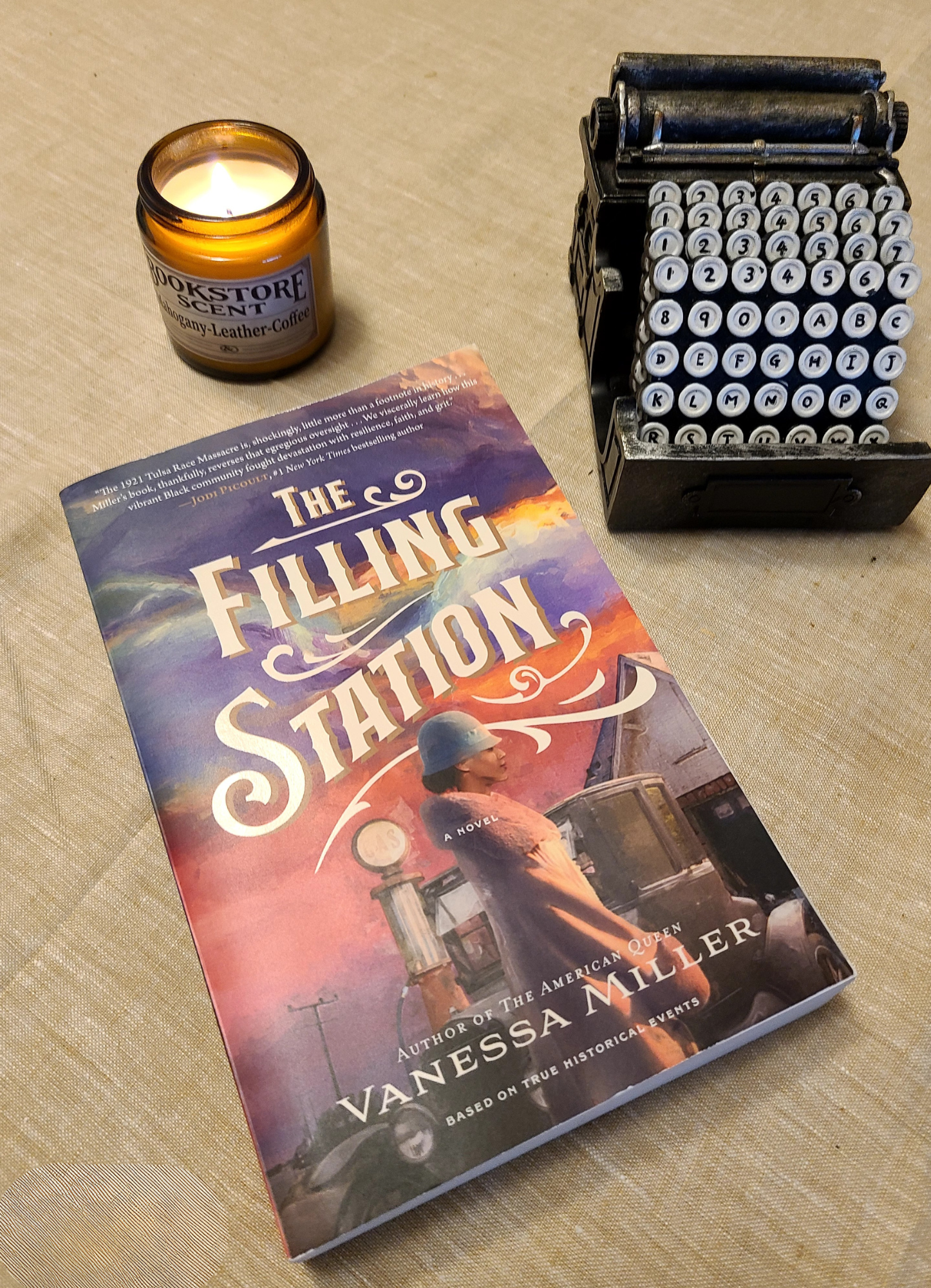
I highly recommend The Filling Station be added to your To-Be-Read pile. It is a USA Today bestseller, a Library Journal ‘Best Books of 2025’ pick, and a Booklist Editors’ Choice Pick for 2025.
You can find this book on Amazon at https://amzn.to/4s81Sau


 M.B. Gibson Books
Leave a comment