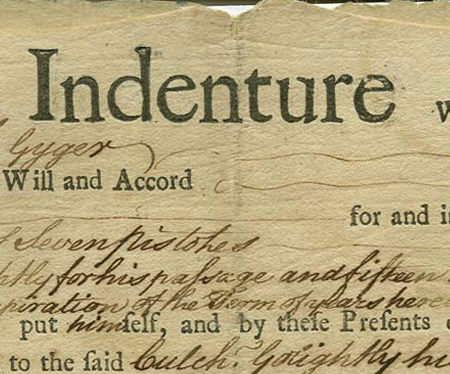
History books have little more than a sentence or two, explaining that this was an honorable method for the poor, but hard-working to finance their passages across the Atlantic. The textbook, The American Journey, says “Other men, women, and children came to the colonies as indentured servants. In return for the payment of their passage to America, they agreed to work without pay for a certain period of time.”
Sounds fair.
Walter Edgar doesn’t give it much more coverage in South Carolina: A History. He tells of the Bounty Act of 1761 where the colonial government promised four pounds Sterling ($360) for each white immigrant imported into South Carolina. These immigrants were to be given an additional twenty shillings ($90) as start-up money. Yet a prominent South Carolinian called it “more cruel than the slave trade.”
Edgar, however, like most all other references to indentured servitude, soft pedals it. “Selling their children as servants was simply a means for paying the family’s way to South Carolina,” he writes. Also, “Thrifty and industrious, the Germans of Orangeburg and Amelia turned their townships into the breadbasket of South Carolina.”
A little digging outside the traditional history books, however, tells quite a different story. I’ve recently been listening to the audiobook version of Lies My Teacher Told Me by James Loewen that exposes the patriotic spin given to most school history texts. You may be astounded, as I have been, by the omissions, slants, and outright myths perpetrated by texbook writers in an effort to present our past in the best possible light. The distortions we’ve been fed on the lot of indentured servants is another such effort.
In my next post, I will tell the true tale from the mouth of a German immigrant, Gottlieb Mittelberger, who wrote “On the Misfortune of Indentured Servants” in 1754.
A voyage to the dark side.

 M.B. Gibson Books
Leave a reply to barb Cancel reply