A Natchez, Mississippi man named Ron Miller, looking to improve his community, hosted a federal official who could help finance his project. Miller took the official out on the town. At the midnight hour, the visitor asked to visit a well-known local bordello, Nellie’s. Just out of curiosity.

As was the practice, Miller took the man to the back door.
A young woman answered. “What do you want?”
Miller explained they’d like to drink a couple of beers and talk.
“We don’t sell beer.” The woman bluntly told him what they did sell. “When you want some of that, you can come back.” She shut the door.
Nellie Jackson was a rare occurrence—a black woman in the 1930s who openly ran a whorehouse in the middle of the Jim Crow South. She did so successfully for sixty years.
How did she manage it?
For one, as former Mayor Tony Byrne, said, “We’re different in Natchez.”
A river town, the people there grew up with whiskey, gambling, and ladies of the night.
But Nellie’s life was not so simple. Despite being a secret FBI informant, she lived to be eighty-seven years old when she met a tragic end.
No one is sure why, in 1923, Nellie Jackson moved with her husband and two children to Natchez from a pinpoint on the Mississippi map named Possum Corner. One year later, she divorced the man she may have used to free herself from that tiny crossroads.
Her daughter died of appendicitis at age eleven, and her son, at four years old, died when he got hold of poison and drank it. Then alone, we can only wonder at her circumstances. But they led her to Natchez Under the Hill, along the riverfront, where bordellos and bawdy houses were prevalent. A place where young girls put their lives at risk. No one knows how many bodies lie at the bottom of that muddy river.

Nellie was 28 years old when she found the opportunity to move up—literally and figuratively—to the bluff and become the proprietor of what she called a boarding house, filled with her “friends.” Women of every ethnicity and hue stayed with Nellie for one or two months before moving on to another establishment, perhaps to avoid entanglements.
Whatever her talents, Nellie Jackson’s business acumen set her apart. She knew how to run a house of ill fame with all the necessary discretion. A sign of the times she lived in, only white men were welcome, clients she’d never acknowledge in public. It is a matter of some controversy whether she kept a black book, but the possibility kept many in town quiet.
During World War II, a boost to her wealth resulted from the nearby army base, Camp Van Dorn. It’s been said that young soldiers lined up for two or more blocks outside Nellie’s.

Many in her neighborhood benefited from her generosity. Nellie kept the surrounding houses painted and helped the children with their school clothes and supplies. She took food and gifts to the Home for Abused Children. In the 1960s, many black young people of Natchez marched as part of the Civil Rights Movement. Hundreds were arrested. At a risk to her business, Nellie Jackson went downtown and insisted they be released. To the surprise of the black community, the powers that be listened to her. She paid the protesters’ bail and they were released.

In reaction, the Ku Klux Klan’s assaults and acts of intimidation surged. Soon, the FBI was publishing their individual names in the paper. Employers took that seriously. According to former Mayor Byrne, people started “denying it, hiding their robes, burning their robes, and everything else. It pretty much broke it up.”
Apparently, they never guessed it was their visits to Nellie’s that did them in. Two FBI agents visited her establishment each night around two A.M. where Nellie would give them each a beer and tell them everything her girls learned from their Klan clients. Had they known Nellie was a “snitch”, her house would likely have been burned to the ground.
Many years later, it was.
On July 4,1990, college students were home and celebrating the holiday. One young man, Eric Breazeale, was dating a local girl and attended the parties. Apparently, he was particularly obnoxious and asked to leave more than one location. Angry and frustrated, he decided to visit Nellie’s.
She answered the door herself. When she saw the state he was in, she refused to allow him in. This further infuriated Eric. He walked two blocks to a convenience store, bought an ice chest, and filled it with gasoline. Likely unsteady, he carried the ice chest back to Nellie’s with gas sloshing the whole way.
Once again, he knocked on Nellie’s back door. This time, Nellie answered with her pistol, which she was not shy about using. When Eric saw the gun, he threw the gasoline onto the eighty-seven-year-old woman and set her aflame with his lighter. With all the gasoline splashed onto himself, he, too, lit up.
A neighbor saw the fireball that was Eric run across the street. When the neighbor ran toward him, he said, “Ma’am, don’t come down here. I used to be a nice-looking guy, but I’ve messed myself up now.”
A cop on patrol saw Eric flailing and on fire, but thought he was a stuntman. Apparently, many movies are filmed in Natchez.
The front porch and just inside the front door burned. The fire department arrived, and Nellie was still inside. When found not far inside the house, she was badly burned but still alive. Within days, both victims had died. A legend was gone.
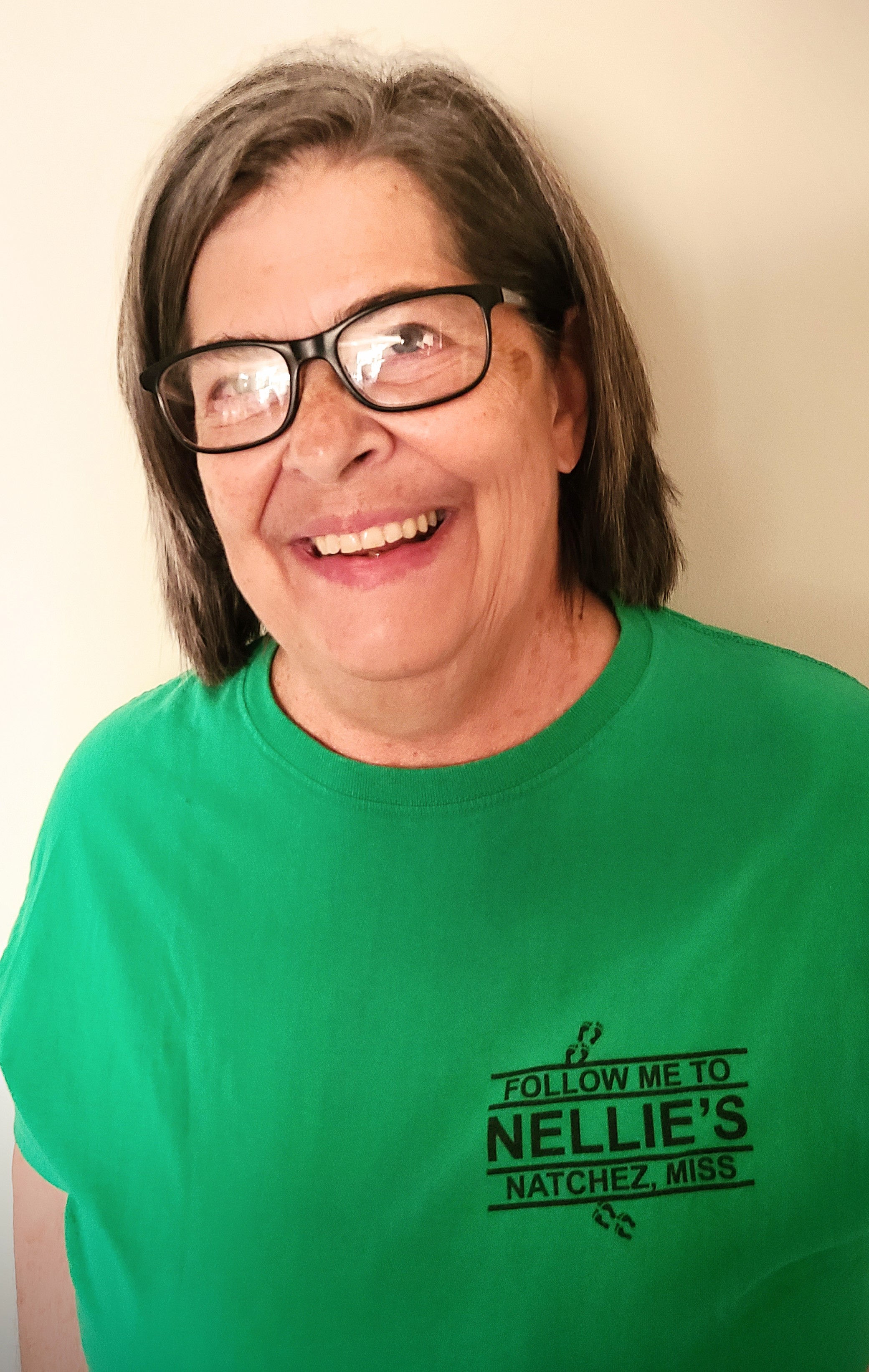
In the 1980s, Nellie had t-shirts made that say “Follow me to Nellie’s, Natchez, Mississippi.” I have one myself. One Natchez man was in the military in Brussells, Belgium years ago. At the airport, he saw a fellow in line ahead of him wearing one of the shirts. So excited to see it in Europe, he ran up and spoke to the man, only to have him respond in Swahili. Nellie Jackson had become an international figure.
As Natchez Alderman Paul O’Malley said, “She was the sort of person who was living in the presence of both the devil and the Lord.”
Isn’t that a bit true of all of us?
RESOURCES:
Givens, Timothy and Mark K Brockway, directors. Mississippi Madam: The Life of Nellie Jackson. https://www.amazon.com/Mississippi-Madam-Life-Nellie-Jackson/dp/B07VWM1L1H/ref=sr_1_1?crid=2EJHNUQ3LXN0R&keywords=mississippi+madam+the+life+of+nellie+jackson&qid=1669689673&s=instant-video&sprefix=nellie+jackson%2Cinstant-video%2C1162&sr=1-1. Accessed 28 Nov. 2022.
Grant, Richard. The Deepest South of All: True Stories from Natchez, Mississippi. Simon & Schuster Paperback, 2021.


 M.B. Gibson Books
Leave a comment